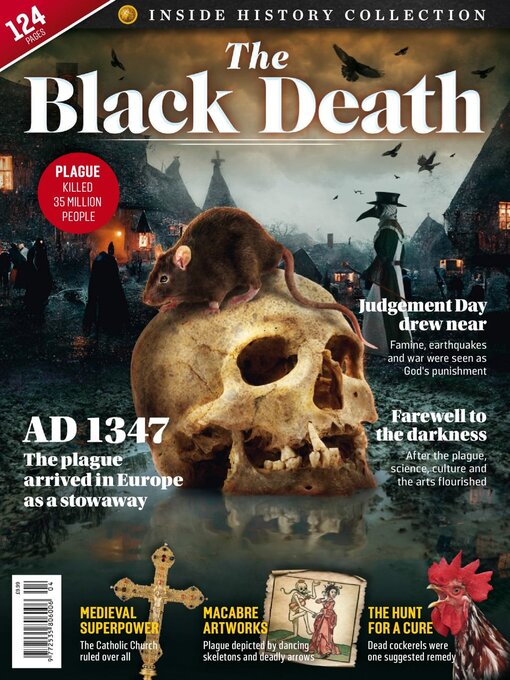
 The Black Death
 Secret Societies
 The Bloody Birth of the United States
 The Crusades
 Secrets of the ancient EGYPTIANS
 Ancient ROME
 Ice cold SERIAL KILLERS
 Bible - History and Myth
 History’s greatest mysteries
 Knights Templar - Lost secrets revealed
 The vikings - Final Secrets Revealed
 Vikings
 History’s 50 greatest mysteries
 Bloody revolutions
 Events that changed the world
In this series, you are taken back to the dramatic events, who have shaped world history for better or for worse. From the construction of the first cathedrals in Europe of the plague to the landing in Normandy in 1944. From the crusaders' bloody marches towards Jerusalem to the daring pilots who gave man air under his wings. Along the way, you will be enlightened in an entertaining way as to why the events took shape as they did. This series has the dramatic narrative as its focal point. You not only get an overview of history's most significant events, but also captivating human destinies, spectacular feats, and history's greatest heroes and villains brought to life.
THE BLACK DEATH LED TO A NEW EUROPE
PRELUDE TO THE PLAGUE 1000-1315 • In the centuries before the plague struck, Europe was a good place to live. More peaceful and more prosperous than it had been for a long time. A mild climate and improved agricultural methods fuelled a growing population, and where people congregated, towns sprang up, recreating a way of life that had been in retreat since the collapse of the Roman Empire in the fifth century. Merchants and craftsmen amassed great fortunes and affluent cities attracted the hopeful from far and wide.
CHURCH RAN EUROPE 313-1378 • Across medieval Europe, imposing cathedrals soared skywards, reminding the faithful of God’s greatness, while wealth poured into bishops’ coffers. In the centuries following the fall of the Roman Empire, the Catholic Church enjoyed a meteoric rise, and what had once been an obscure and persecuted sect became a European superpower in the hands of the Middle Ages’ highly organised clergy. Nothing, it seemed, could shake the mighty Church. At least, not until the plague struck.
THE BLACK DEATH 1346-1351 • One fateful day in 1346, a hail of corpses rained down on the Crimean trading port of Kaffa. The bodies were those of plaguestricken Turkic Tatars who had laid siege to the town and then tried to defeat Kaffa’s Italian merchants with the stench of the dead. The macabre ammunition worked better than the Tatars had dreamed. The corpses spread the infection behind the city walls, and when the merchants fled to Sicily, they took the plague with them. Over the next four years, the dreaded Black Death wiped out up to half of Europe’s population.
BLAMED FOR THE PLAGUE 1348-1350 • No sooner had the plague struck Europe than angry and helpless people began to look for someone to blame. No one who strayed even slightly outside society’s norms was safe from persecution and irate mobs. Primarily, however, plague-fearing Europeans targeted one group of people who were often made scapegoats when things went wrong during the Middle Ages: the Jews.
MONKS DIED IN DROVES 530-1400 • In 1349, the plague took hold in the East Yorkshire monastery of Meaux Abbey, killing an abbot and five monks in a single day. Soon the brothers’ agriculture and finances were in ruins, and four out of every five Meaux monks were in the ground before the dreaded disease had run its course. It was not an isolated case. Monks and nuns across Europe saw it as their duty to welcome strangers and care for the sick who knocked at their doors. But their guests brought the Black Death with them, and contagion soon flourished within the communes’ walls.
DEATH IN THE ARTS 1350-1563 • Death is a veiled woman hurling deadly arrows left and right. That is how a painter in Lavaudieu in France chose to depict the terrible plague that had just ravaged Europe in around 1355. Arrows became a recurring symbol of the plague and appeared in artistic depictions of the Black Death throughout the late Middle Ages. Another favourite motif was the Dance of Death, in which skeletons lead a long line of people to the grave. The taste for the macabre also resulted in funerary monuments depicting the deceased as a...